
Underground Systems — Municipal & Rural
Power that disappears below grade and stays on above it — buried line that shrugs off storms, ice, and the years.
Services we provide
- Installing URD wire from the substation to the transformer pad to the house meter
- Plowing single-phase to three-phase (#1 to 500 MCM)
- Installing pad-mount transformers and junction boxes
- Installing switch gear
- Installing wire, primary and secondary
- Installing interduct
- Terminating and splicing
- Cable pulling
Out of the weather, out of sight
Overhead line is fast and cheap to build, but it lives exposed — to ice, wind, falling limbs, and the occasional errant vehicle. Underground, the same circuit is out of the weather and out of sight. For a downtown that wants clear sightlines, or a co-op tired of chasing the same storm-prone tap year after year, going below grade trades a higher day-one cost for outages that mostly stop happening.
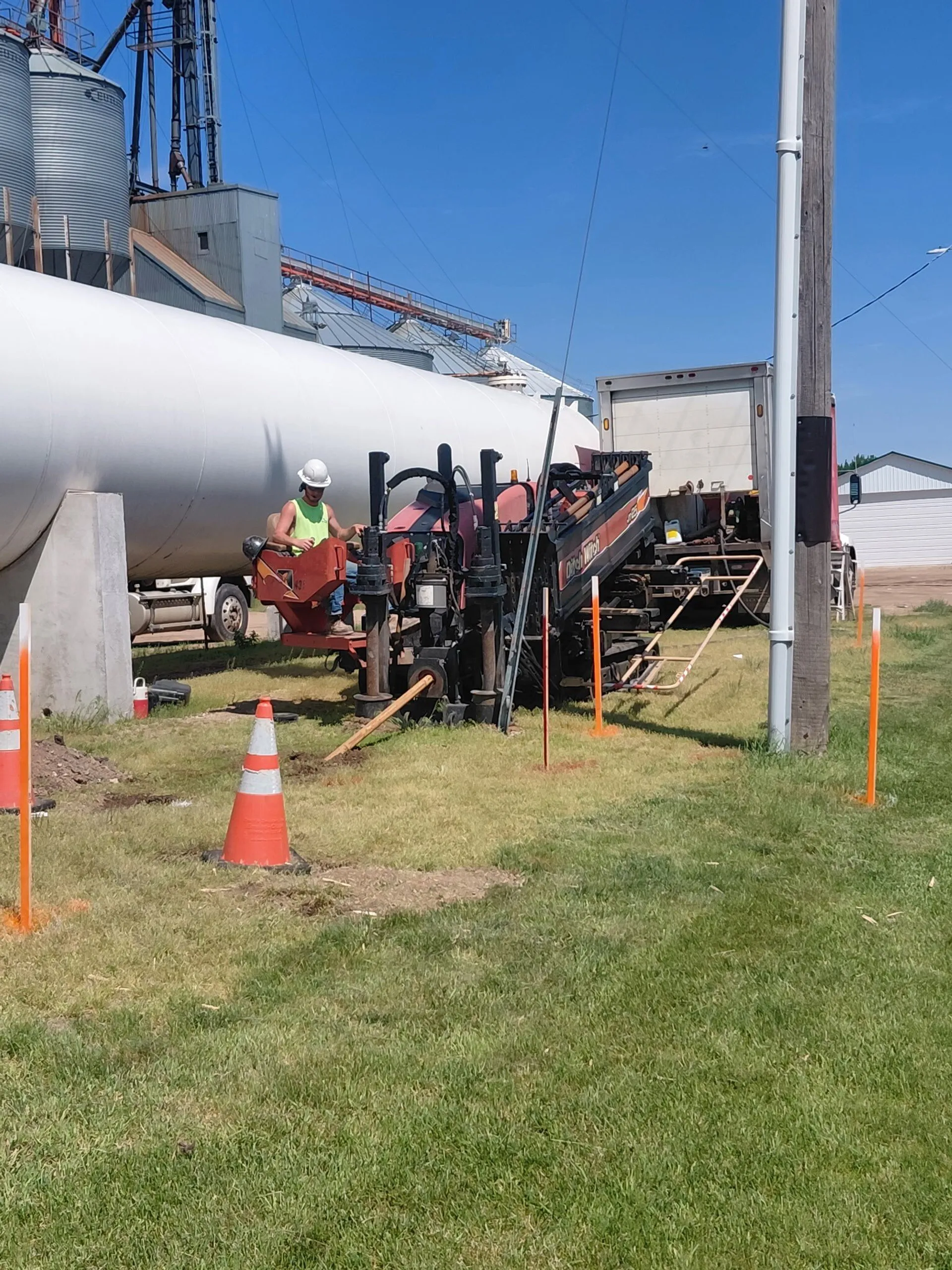
Out in the country the problem flips — long runs, road and waterway crossings, and soil that changes by the quarter-mile. We bore conductor under a highway or a creek without trenching it open, so the road stays whole and the line stays protected. Town or rural, the goal is the same: dependable power and a clean surface left behind.
How we put it underground
-
Locate & plan
Before anything breaks ground we locate existing utilities, confirm the route and depth, and plan the crossings — so the dig avoids what’s already down there and the schedule respects the street.
-
Bore or trench
Directional boring under roads, waterways, and finished surfaces where open-cut would do damage; clean trenching where it’s faster and the ground allows. The method fits the site, not the other way around.
-
Conduit & cable
Place conduit and duct, then pull primary cable to engineered tensions so it isn’t stressed going in — the kind of care that decides whether a circuit lasts ten years or forty.
-
Splice & terminate
Splice, terminate, and tie into transformers, pad-mounted gear, and the overhead system where it surfaces — tested and proven before it carries load.
-
Restore the surface
Backfill, compact, and put it back the way we found it — pavement, curb, and turf — so the only sign we were there is that the lights stay on.
What this means for you
- Storm-proof by design — buried line doesn’t care about ice, wind, or falling limbs, so the outages that plague overhead taps largely stop.
- A clean above-ground footprint — clear sightlines downtown and uncluttered rural corridors, with nothing for weather or traffic to hit.
- Built to last decades — conduit and properly tensioned cable engineered for the long haul, not the quick fix.
- Minimal disruption — directional boring crosses roads, creeks, and finished surfaces without tearing them open.
- Surfaces restored, not abandoned — pavement, curb, and landscape put back so the community is left whole.
- Below grade out of the weather
- Trenchless road & water crossings
- Town & rural municipal and co-op work
- Zero major accidents since 2000
What we've done
Municipal utility
Installed PMH switches and rerouted the main feeders through town.
Investor-owned utility
Converted the hospital's overhead service to underground.
Electric cooperative
5.5 miles of plowing and boring.
Thinking about going underground?
Tell us about the corridor — downtown block or country mile — and we’ll lay out the approach.